
Some blog entries age well. This won’t.
At age 19, I made a “global macro” call. Unmotivated in school, I fell into a unique opportunity to spend a year of college in Varanasi, India. Following the jolt of arrival, I felt I understood the world clearly for the first time, existence stripped down to essentials. I could see – accurately, it turned out – that the developing world would become increasingly competitive, whereas Western societies faced growing cracks we were not addressing. Life would get harder for Americans, in other words. This realization shocked me into graduating summa cum laude with a major in developing countries. I was meanwhile correct in predicting an increasingly competitive world, and its accompanying societal stresses.
Now decades into an investment career, I try to avoid macro calls. Nobody can reliably predict interest rates, energy or commodity prices, or equity markets, and when someone guesses correctly, distinguishing skill from luck can be nearly impossible. Our “smart money” approaches provide no edge.
We are now, however, making another global macro call. We are substantially reducing US exposure in favor of international for all of our clients.
Like everyone, we have followed recent moves from tariffs to territorial aggrandizement while noting the increasingly forbidding environment for research. What jolted us into awareness, however, was the $100,000 H-1B visa announcement in late September 2025. The US seems no longer keen to attract the world’s brightest lest they compete against those of us already here. All of the above simply fell into place. Our quantitative finance work attracts a steady flow of master’s and occasional PhD interns from Ivies and equivalents, a group we see now starting to leave the US. This concerns us. We believe that tomorrow’s greatest companies will increasingly arise abroad, and we are reallocating accordingly.
Although we manage our InsideTrack® portfolios on discretion, we felt this long-term shift toward international was a move to make only client by client after discussing upsides against risks. We serve savvy investors, mostly current or former public company insiders with both red and blue leanings. With a single exception, however, none had considered greater international exposure as a response to the current US risk environment. That said, every individual bought into our idea immediately, sometimes before we could complete our thoughts.
An important question was how far to take this. We are incrementalists, not radicalists, so our thinking to increase from ~20% international to 37.5% seemed intrepid. Was 37.5% too much, I asked a friend, a former Wall Street trader turned investment advisor? Not having considered overweighting internationally until hearing my thoughts, his response was nevertheless immediate: an allocation of 37.5% hardly seemed like enough!
American investors these days seem inwardly focused, lately thinking perhaps about AI and the Magnificent Seven vs the other ⅔ of the S&P 500 market capitalization that lags by comparison, and all of today’s political noise. International investing just seems to have slipped the mind.
We thought we had been clever. But then we looked at the rest of the world. As the saying goes in finance, money flows to where it is treated best. See below.
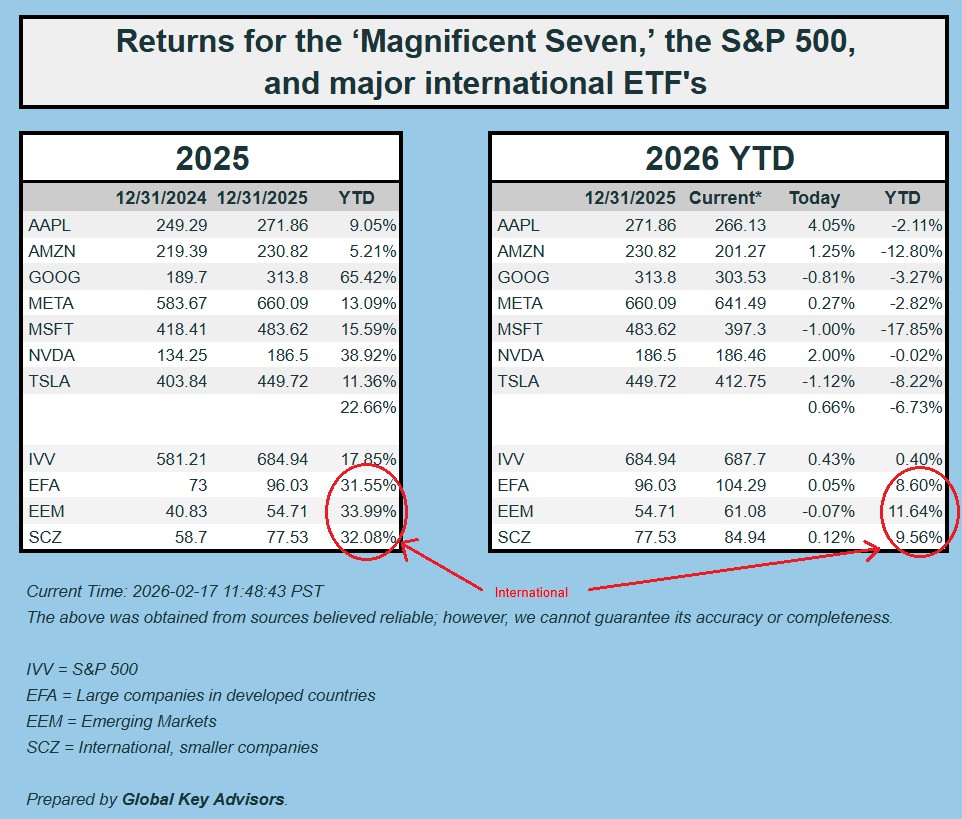
In this spreadsheet, the pattern we saw in early October 2025, when starting our international shift, is roughly how 2025 ended. In the US, the “Magnificent Seven” drove most S&P 500 returns, with the other nearly 500 stocks trailing in single digits. But the unnoticed observation worth adding here is that non-US equities performed exceptionally well by comparison. You can see this international pull-away accelerating as we get into 2026. It seems, though, that the financial press and the non-clients we speak with are barely taking note. Not yet. I think American investors are currently in a bubble. This will change, but we are placing our bets now. Meanwhile, the world already seems to be voting with its feet.